


If you have questions or just want to start a conversation with us, please fill in the form or send us an email at:

Blog
Winning the Persuadable Middle: What AEI’s New Polling Means for the Starter Home Abundance Agenda
08-25-2026
America’s housing debate often treats public opinion as a simple contest between pro-housing reformers and anti-growth opponents. But new polling from the AEI Housing Center suggests a more useful way to think about the politics of starter home abundance: the key audience is not the strongest supporters or the hardest skeptics. It is the persuadable middle.
The AEI Housing Center’s May 2026 Zoning and Land Use Flexibility Survey finds broad support for practical housing-supply reforms. Among respondents with an opinion, 74 percent support allowing more homes near shops, restaurants, and jobs; 64 percent support allowing smaller lots in new neighborhoods; and 58 percent support allowing smaller-lot homes, duplexes, townhomes, and single-family homes in existing single-family neighborhoods. But the survey also shows that support is conditional. Many Americans like the idea of more attainable homes, especially starter homes people can own, but they want reassurance that reform will be gradual, practical, and sensitive to neighborhood concerns.
That is where the persuadable middle comes in.
In the survey, respondents were grouped based on two barriers to reform: supply skepticism and neighborhood change aversion. Supply skepticism is the “why do this?” barrier: doubt that allowing more homes, or more starter homes on smaller lots, will improve affordability. Neighborhood change aversion is the “not here” or “not like this” barrier: concern that reform will change existing neighborhoods too quickly or too directly.
The persuadable middle consists of respondents with mixed or partial barriers. They are not fully sold on starter-home reform, but they are not closed off to it either. They represent 34 percent of the public, making them nearly as large as the most supportive group.
Table 1. Four groups based on supply skepticism and neighborhood change aversion
| Group | Definition | Share |
| Reform supporters | Low supply skepticism + low neighborhood change aversion | 36% |
| Persuadable middle | Mixed or partial barriers | 34% |
| Change-averse but supply-open | High neighborhood change aversion, but not high supply skepticism | 15% |
| Reform skeptics | High supply skepticism + high neighborhood change aversion | 15% |
The persuadable middle already supports all three core reforms by majority margins: 64 percent support smaller lots in new neighborhoods, 60 percent support small-scale infill in existing single-family neighborhoods, and 76 percent support homes near jobs and amenities. That makes the task less about changing minds from no to yes than about making existing support firmer, better informed, and more visible.
Figure 1. Support for Strong Foundations Playbook reforms by barrier group
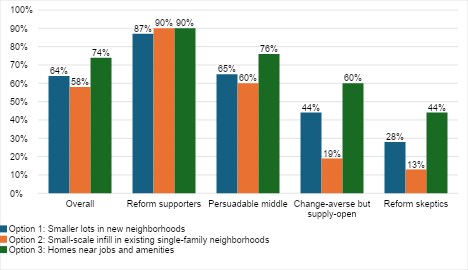
That finding changes the strategic task. Reformers should not spend most of their energy preaching to committed YIMBYs or trying to convert the hardest skeptics. The strongest supporters are already convinced, though they still need to be mobilized. The hardest skeptics are unlikely to move quickly. The pivotal audience is the persuadable middle: residents who often already support starter-home reform, but whose support is conditional, quiet, and vulnerable to fears about neighborhood change. The goal is to make that support firmer, better informed, and more visible before opponents define the debate.
The persuadable middle is not a narrow ideological bloc. It is politically mixed, majority-owner, plurality suburban, and split across age groups. In many respects, it looks more like the overall public than either the most enthusiastic reform supporters or the most resistant skeptics. Its members are close enough to the affordability problem to be reachable, but cautious enough to need reassurance that reform will not mean sudden, large-scale neighborhood transformation.
Its hesitation is not mainly about whether starter homes are desirable. The persuadable middle already leans toward starter homes people can own, smaller low-rise homes, and gradual change. The bigger question is whether land-use reform will actually produce attainable homes, where those homes will go, and whether change will feel gradual and manageable. That is the vocabulary reformers should use when explaining starter-home reform.
This has major implications for the starter home abundance agenda. Reformers should not lead with abstract density, zoning mechanics, or procedural language. Those details matter, but they are not the strongest public-facing case. The strongest message among the persuadable middle is starter homes for first-time buyers and young families, with a net support effect of +54. Messages about fewer bidding wars and rising rents (+46), gradual small-scale change rather than high-rises (+45), and building middle-class homes that free up older homes for working households (+40) also perform strongly. The technical zoning and land-cost explanation is positive, but weaker at +27.
These findings reinforce the “pro-homes” messaging work advanced by groups such as Welcoming Neighbors Network and Sightline: focus on people and places, not zoning weeds. The AEI survey adds a complementary point for state reformers: among the persuadable middle, the most effective people-and-place frame is not abundance in the abstract, but abundance made concrete — starter homes for first-time buyers, young families, and workers — paired with reassurance that change can be gradual, low-rise, and practical.
The messenger matters too. Among the persuadable middle, the most trusted source for information about housing reform is housing experts and research organizations, at 31 percent. But trust shifts as barriers rise. More skeptical groups place greater trust in community or neighborhood groups and in relatives or friends. That suggests expert evidence is necessary but not sufficient. The starter home abundance movement needs both credible research and local validators who can make reform feel practical, limited, and community grounded.
Model legislation can give reformers a head start, but the message should stay simple: make small lots legal and prevent local rules from making them unusable. That kind of short, concrete small-lot reform may be the best public entry point for the persuadable middle. Metro Abundance Program’s small-lot starter-home model bill gives reformers a practical way to show what starter-home reform means in practice.
For the starter home abundance movement, the takeaway is encouraging and practical. A lot of progress has already been made: there is a clear starter-home majority, and many persuadable residents already support the basic direction of reform. The opportunity now is to build on that progress by making support stronger, more visible, and easier for policymakers to act on. By leading with starter homes, gradual change, and trusted local voices, reformers can help the persuadable middle see housing abundance not as a disruptive agenda, but as a practical path to more starter homes in the communities people already care about. The result can be a durable starter-home reform majority.
Tobias Peter – Co-Director, AEI Housing Center (Tobias.Peter@AEI.org)
Recent Blogs View All Blogs